
Jonathan Stuck Inside Guinea-Bissau Coup – Army Locks Down Country, Detains President
Credit:
Army officers in Guinea-Bissau have declared “total control” of the country, detaining President Umaro Sissoco Embaló and suspending the electoral process just hours before provisional results from last Sunday’s disputed presidential vote were due to be announced.
The action has plunged the coup-prone West African nation into fresh uncertainty.
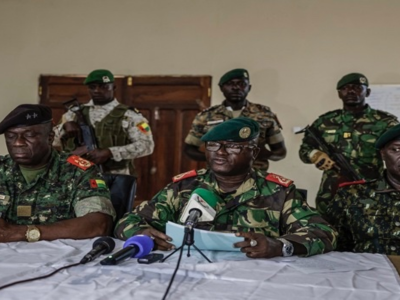
Brigadier General Denis N’Canha, head of the presidential military office, announced the takeover on state television, flanked by uniformed officers. He said the “High Military Command for the Restoration of Order” would govern until further notice, citing an alleged “political plot” uncovered by state intelligence.
Borders and airspace were closed, and a nationwide curfew imposed from 8 p.m. to 6 a.m. Gunfire was reported near the presidential palace, election commission headquarters, and interior ministry, as soldiers patrolled key streets and arrested election officials.
The intervention follows the November 23 general elections, in which Embaló—seeking a second term—and opposition challenger Fernando Capela da Costa both prematurely claimed victory. Provisional tallies were expected Thursday, but the military’s action halted the process amid rising tensions.
Embaló, speaking to Jeune Afrique before his detention, described the events as a “coup d’état” led by the army chief of staff, though he reported no violence during his arrest at the Government Palace.
Opposition figures, including da Costa’s supporters from the PAIGC coalition, dismissed the coup as a “simulated” ploy by Embaló to cling to power after a likely defeat. PAIGC leader Domingos Simões Pereira, barred from running due to a Supreme Court ruling, demanded immediate release of results.
Foreign observers, including former Nigerian President Goodluck Jonathan and delegations from ECOWAS and the African Union, are reportedly stranded in Bissau under the restrictions.
Regional and international bodies swiftly condemned the takeover. ECOWAS and the AU issued a joint statement expressing “deep concern” and demanding Embaló’s release and a return to constitutional order. Ghana, the UN, and the EU echoed these calls, warning of destabilization.
Guinea-Bissau, a fragile coastal state long plagued by political instability and cocaine trafficking, has endured at least nine coups or attempts since independence in 1974. Embaló himself came to power in a disputed 2020 vote marred by violence, and his 2023 dissolution of parliament left the legislature dysfunctional.
Informed observers link the crisis to elite rivalries, economic woes, and drug-fueled corruption, cautioning that suspension of the electoral process could worsen humanitarian needs in a country where over half the population lives in poverty.



0 Comment(s)