
U.S. and Uganda Seal $2.3 Billion Health Pact to Bolster Systems and Curb Outbreaks
Credit:
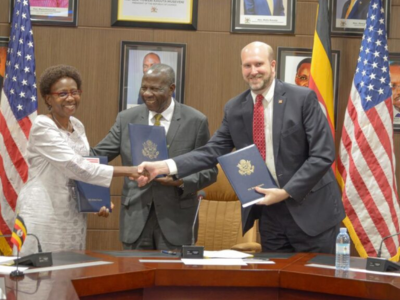
The United States and Uganda have signed a landmark five-year health Memorandum of Understanding (MOU) worth $2.3 billion, aimed at strengthening Uganda’s healthcare infrastructure, combating infectious diseases, and advancing self-reliance in the face of global health threats.
Under the agreement, framed by the America First Global Health Strategy, the U.S. will contribute up to $1.7 billion toward priority areas including HIV/AIDS, tuberculosis, malaria, maternal and child health, polio eradication, disease surveillance, and emergency preparedness. Uganda has pledged to increase domestic health financing by more than $500 million, gradually assuming greater responsibility as U.S. support tapers.
U.S. Ambassador William W. Popp hailed the pact as a “significant shift toward self-reliance,” highlighting investments in training 14,000 community health workers, digitizing medical records, upgrading supply chains, and improving data interoperability to prevent outbreaks from crossing borders. “This builds strong local systems with clear performance metrics and a foundational commitment to global health security,” Popp said.
Uganda’s Finance Minister Matia Kasaija echoed the optimism, stressing that the collaboration would deliver disease-specific results while strengthening national institutions and workforce capacity. “Our increased domestic financing reflects our responsibility to sustain these gains,” he noted.
The MOU introduces sustainability measures: procurement of commodities will transition from U.S.-funded to Ugandan-led systems; frontline health workers already trained will shift to government payrolls; and faith-based providers will receive performance-based grants, primary health care funding, and insurance support.
This pact builds on six decades of U.S.–Uganda health cooperation, with Washington remaining Kampala’s largest partner. It also responds to criticisms of donor dependency by prioritizing “country-led” models, similar to recent U.S. agreements with Lesotho.
As Uganda grapples with Ebola risks and an HIV prevalence of 5.4 percent, the deal could save thousands of lives and boost economic productivity. Analysts caution, however, that success will depend on Uganda’s fiscal discipline amid mounting debt pressures.




0 Comment(s)